Written & medically reviewed by: Dr. S Bhargava Reddy, MBBS, MS (General Surgery), DNB (Urology)
Registration: Telangana State Medical Council — Reg. No. 47350
Published:
Category: Prostate health
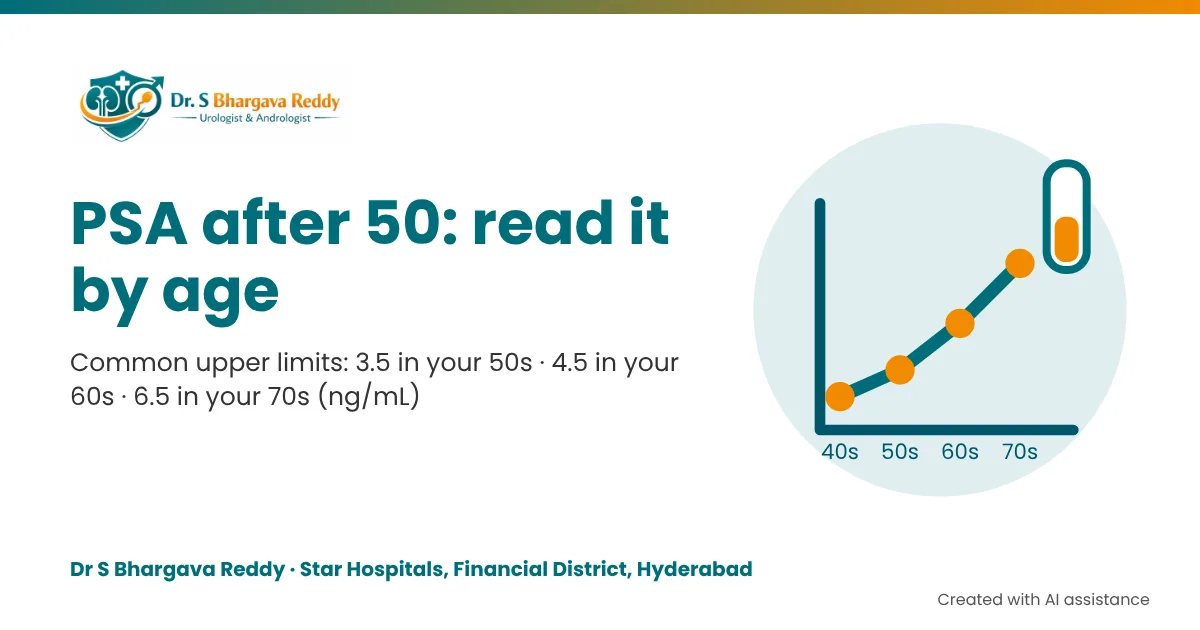
PSA rises with age, so the same number means different things at 50 and 75. Commonly used upper limits are about 3.5 ng/mL at 50–59, 4.5 at 60–69 and 6.5 at 70–79. A higher result means repeating the test and seeing a urologist, not a cancer diagnosis. Most men with a raised PSA do not have prostate cancer.
In this article
- Key points
- What is PSA, and why does it rise with age?
- What is a normal PSA level by age?
- Does a PSA of 4.5 mean I have cancer?
- What can raise PSA apart from cancer?
- How should I prepare for a PSA test?
- When should a PSA test be repeated?
- What happens after a PSA that stays raised?
- From Dr Bhargava's practice
- Who should think about a PSA test?
- Sources
PSA naturally rises as men get older, so the same number means different things at 50 and at 75. Commonly used age-based upper limits are about 3.5 ng/mL for men aged 50 to 59, 4.5 for 60 to 69 and 6.5 for 70 to 79. A result above your age range is a reason to repeat the test and see a urologist, not a cancer diagnosis. Around three in four men with a raised PSA turn out not to have prostate cancer.
Key points
- PSA (prostate-specific antigen) is a protein made by the prostate. Levels rise with age and with prostate enlargement.
- Age-based upper limits are roughly 2.5 (40s), 3.5 (50s), 4.5 (60s) and 6.5 ng/mL (70s), but labs and doctors use different cut-offs.
- Infection, recent cycling or heavy exercise, recent ejaculation and some procedures can raise PSA for a while.
- A single high reading is usually repeated after a few weeks before any further tests.
- A normal PSA does not completely rule out cancer, so symptoms and family history still matter.
Dr S Bhargava Reddy is a urologist (MBBS, MS (General Surgery), DNB (Urology)) practising at Star Hospitals, Financial District, and Sri Sri Holistic Hospitals, Nizampet, Hyderabad. This guide explains how he reads a PSA report for men over 50, and when a repeat test makes more sense than further investigation.
What is PSA, and why does it rise with age?
PSA is a protein made by cells of the prostate gland, and a small amount normally passes into the blood. As men age, the prostate usually grows larger, a non-cancerous change called benign prostatic hyperplasia (BPH). A bigger gland makes more PSA, so the level creeps up with age even when everything is healthy. Our article on BPH and prostate cancer explains the difference between the two.
What is a normal PSA level by age?
There is no single normal PSA for every man. Many urologists use age-based upper limits, so a man in his 50s is compared with men in his 50s, not with men in their 70s. The ranges below are widely used, including in UK referral guidance.
| Age | Commonly used upper limit (ng/mL) |
|---|---|
| 40–49 | 2.5 |
| 50–59 | 3.5 |
| 60–69 | 4.5 |
| 70–79 | 6.5 |
Some labs print a single cut-off of 4.0 ng/mL for everyone, and the NHS treats 3 ng/mL or more as raised for men aged 50 to 69. A study of healthy Indian men found typical PSA values that were low and rose steadily with age, and PSA is known to vary between populations. This is why your urologist reads the number alongside your age, prostate size, symptoms and earlier results. ⚠️ Doctor to confirm which cut-offs he uses.
Does a PSA of 4.5 mean I have cancer?
No. A raised PSA is a reason to look more closely, not a diagnosis. Around 72 to 80 percent of people with a raised PSA do not have prostate cancer, according to Cancer Research UK. At 65, a PSA of 4.5 is within the commonly used range for your age. At 52, it would usually be repeated and discussed with a urologist.
The reverse also holds. A normal PSA does not completely rule out prostate cancer, so symptoms, a strong family history and the doctor's examination still count.
What can raise PSA apart from cancer?
- An enlarged prostate (BPH), the most common reason.
- A urinary tract infection or inflammation of the prostate (prostatitis).
- Ejaculation in the previous 48 hours.
- Vigorous exercise or cycling in the previous 48 hours.
- A recent catheter, cystoscopy or prostate biopsy.
- Difficulty passing urine with a full bladder (urinary retention).
Some medicines used for prostate enlargement and hair loss can lower PSA, so always tell your doctor about every medicine you take. ⚠️ Doctor to confirm.
How should I prepare for a PSA test?
- Avoid ejaculation for 48 hours before the test.
- Avoid heavy exercise and cycling for 48 hours before the test.
- If you have a urine infection, wait until it has been treated and then a further 4 to 6 weeks before testing.
- Wait at least six weeks after a prostate biopsy or other prostate procedure.
- Eat and drink as usual. You do not need to fast.
- Use the same lab for repeat tests where possible, so results are easier to compare.
When should a PSA test be repeated?
If your PSA is a little above the range for your age, the usual next step is to repeat it in a few weeks, after ruling out infection and avoiding the things that raise it. If it is still high, your urologist will talk about further tests. If you have had a urine infection, the repeat test is done about six weeks after the infection has been treated, as UK guidance suggests.
If your PSA is normal and you choose to keep testing, the gap between tests depends on your age and how low the result is. Men with a low PSA are often re-tested every two years rather than every year. ⚠️ Doctor to confirm the intervals he recommends.
What happens after a PSA that stays raised?
A persistently raised PSA leads to a conversation, not straight to a biopsy. Your urologist may examine the prostate, check a free PSA (the share of PSA not bound to proteins in the blood, which is often higher in BPH), work out PSA density from the prostate size, and arrange an MRI scan of the prostate. A biopsy is advised only if these results point that way.
From Dr Bhargava's practice
⚠️ Doctor to add or confirm: a general observation, for example how often a worrying PSA turns out to be linked to a recent infection or a long cycle ride, and how a simple repeat test changes the picture. No patient details.
Who should think about a PSA test?
PSA testing is not recommended as routine screening for every man, according to the US National Cancer Institute, because it can lead to tests and treatment for cancers that would never have caused harm. Most guidelines suggest that men from about 50 talk through the pros and cons with their doctor and decide together. Men whose father or brother had prostate cancer may start that conversation earlier, from around 45. ⚠️ Doctor to confirm.
Men with urinary symptoms, such as a weak stream or getting up often at night to pass urine, should see a doctor whatever their age. Read more on when to see a urologist in Hyderabad.
Sources
- NHS: PSA test
- Cancer Research UK: PSA testing (guidance for health professionals)
- National Cancer Institute: Prostate-Specific Antigen (PSA) Test
- Indian Journal of Medical Research: A hospital-based study on reference range of serum PSA levels
This article is for general information only and is not a substitute for a medical consultation. Consult a qualified doctor if symptoms persist.
Frequently Asked Questions
Can a urine infection raise PSA?
Yes. A urinary tract infection or prostatitis can push PSA up sharply, and it may stay raised for several weeks. Doctors usually repeat the test about six weeks after the infection has been treated before deciding on further tests.
Is a PSA of 4 normal at 65?
For a man in his 60s, a commonly used upper limit is 4.5 ng/mL, so a PSA of 4 is within that range. Your urologist will still look at whether it has risen quickly since your last test and at any symptoms you have.
Should I stop cycling before a PSA test?
Yes. Cycling and other vigorous exercise can raise PSA for a short time, so avoid them for 48 hours before your blood test.
Does a high PSA always need a biopsy?
No. A raised PSA is usually repeated first. If it stays high, an examination, free PSA, PSA density and a prostate MRI help decide whether a biopsy is needed at all.
Can PSA go down on its own?
Yes. If the rise was caused by an infection, recent exercise, ejaculation or a procedure, PSA often comes back down on a repeat test a few weeks later.
Which doctor should I see about a high PSA?
A urologist is the right doctor to interpret a raised PSA and plan any further tests. Your family doctor can help arrange a repeat test first.
This article is for general awareness and does not replace a consultation. Please see a qualified doctor for advice about your condition.