Written & medically reviewed by: Dr. S Bhargava Reddy, MBBS, MS (General Surgery), DNB (Urology)
Registration: Telangana State Medical Council — Reg. No. 47350
Published:
Category: Kidney Stones
The choice between RIRS, ESWL and PCNL depends mainly on the kidney stone's size, where it sits, how hard it is and the person's health. In international guidelines, stones under 10 mm are usually treated first with ESWL or RIRS, while stones over 20 mm are usually treated with PCNL. Between 10 and 20 mm, any of the three may suit, depending on the stone and the person.
In this article
There's no single right answer, and that is the honest place to start. The choice between RIRS, ESWL and PCNL mostly comes down to how big the stone is, where it sits in the kidney, how hard it is, and your general health. As a broad rule in international guidelines, smaller stones are often treated with shock waves (ESWL) or a thin flexible scope (RIRS). Larger stones, usually over 2 cm, are more often removed through a small opening in the back (PCNL).
Dr S Bhargava Reddy is a urologist practising at Star Hospitals, Financial District, and Sri Sri Holistic Hospitals, Nizampet, Hyderabad. This guide explains how the three treatments differ, what recovery usually involves and what affects the cost, so you can go into your consultation with clearer questions.
Key points
- Stone size and position matter most. Under 1 cm, ESWL or RIRS are usually the first options. Over 2 cm, PCNL usually is.
- ESWL needs no cut or scope, but it needs repeating more often than RIRS.
- RIRS reaches the kidney through the urinary passage. A temporary stent is often left in for a few days.
- PCNL goes through a small opening in the back and usually means at least one night in hospital.
- Cost depends on the procedure, the stone, the hospital stay and your insurance. Ask for a written estimate.
What are RIRS, ESWL and PCNL?
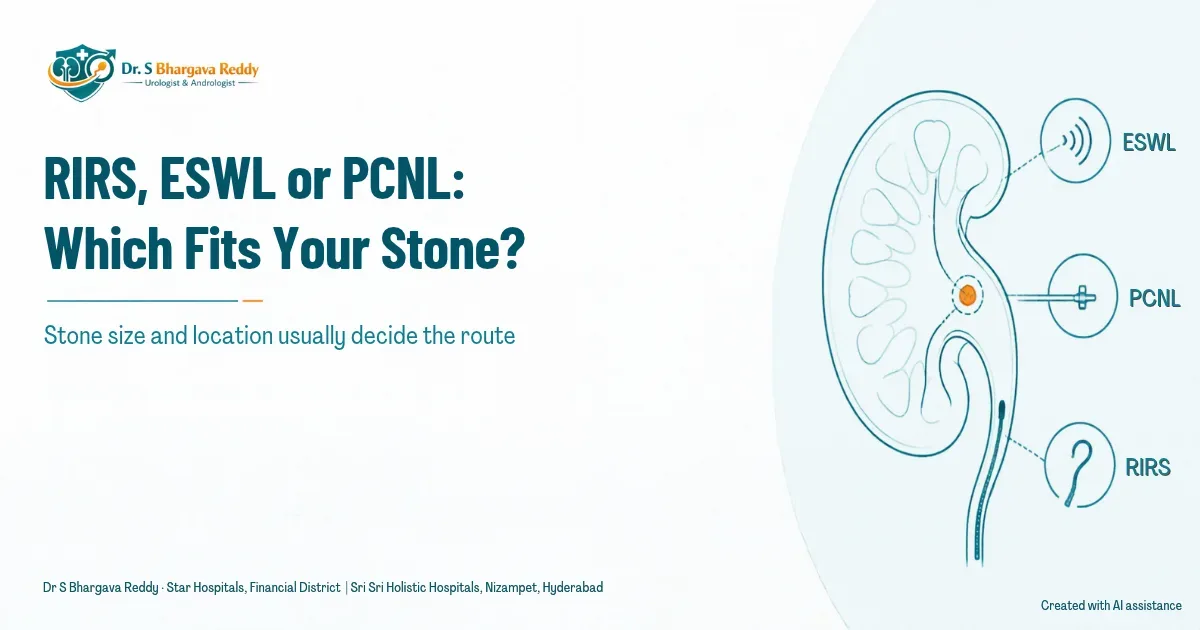
All three are ways to break up or remove a kidney stone that is too large to pass on its own. The difference is how they reach the stone. ESWL works from outside the body. RIRS goes up through the urinary passage with a scope. PCNL reaches the kidney directly through the back.
- ESWL (extracorporeal shock wave lithotripsy): imaging locates the stone, and a machine outside your body sends focused shock waves that break it into small pieces. You then pass the pieces in your urine over the following weeks. Depending on the hospital, it is done with you awake or with light anaesthesia.
- RIRS (retrograde intrarenal surgery): a type of flexible ureteroscopy. A thin telescope is passed through the urethra (the tube you pass urine through), the bladder and the ureter into the kidney, and a laser breaks the stone. There is no cut on the skin, and it is done under general anaesthetic.
- PCNL (percutaneous nephrolithotomy): "percutaneous" means "through the skin". A small opening is made in the back, and a telescope called a nephroscope is passed into the kidney to break and remove the stone. It is done under anaesthetic in hospital, and a laser may be used to break larger stones.
If you are weighing RIRS against laser treatment for a stone in the ureter, see RIRS vs laser lithotripsy explained.
Which treatment suits which stone size?
The European and American urology associations both use stone size as the first filter. For kidney stones under 10 mm, ESWL or RIRS are usually first-line. Between 10 and 20 mm, any of the three may be used, depending on where the stone sits and how hard it is. Above 20 mm, PCNL is generally the first choice.
| Stone in the kidney | Usually considered first | Also used |
|---|---|---|
| Under 10 mm | ESWL or RIRS | PCNL (second line) |
| 10–20 mm, upper or middle kidney | RIRS, PCNL or ESWL | Depends on stone factors |
| 10–20 mm, lower pole | PCNL or RIRS, if factors don't favour ESWL | ESWL |
| Over 20 mm | PCNL | RIRS or ESWL (second line) |
The "lower pole" is the bottom part of the kidney. Stone fragments drain from there less easily, which is one reason the advice changes for stones in that spot.
What else decides the choice besides size?
Size is only the starting point. Your urologist also looks at where exactly the stone sits, how dense it looks on a CT scan, the shape of your kidney's drainage system, your body build, whether you take blood thinners and whether you are pregnant. What matters to you, such as time off work or avoiding repeat sessions, counts too.
- Stone hardness and position. Very dense stones, some stone types and a narrow or steep drainage channel from the lower kidney all make ESWL less likely to work.
- Blood thinners. When blood-thinning treatment can't be stopped, both European and American guidelines prefer ureteroscopy, which includes RIRS.
- Pregnancy and bleeding disorders. European guidelines list both as reasons to avoid ESWL. In pregnancy, any treatment is planned together with the obstetrician.
From Dr S Bhargava Reddy's practice: Many people come to the OPD asking for "laser" by name, before we have looked at the CT scan together. Once we go through the scan, the right route is usually much clearer.
How do recovery times compare?
After ESWL or ureteroscopy (including RIRS), many people go home the same day and return to normal activities in about two to three days. After PCNL, an overnight hospital stay is common, and a return to normal activities usually takes about one to two weeks.
| ESWL | RIRS | PCNL | |
|---|---|---|---|
| Cut on the skin | None | None | Small opening in the back |
| Anaesthesia | None or light anaesthesia | General | General |
| Usual hospital stay | Usually same day | Often same day | Overnight, sometimes a few days |
| Tube afterwards | Usually none | Temporary stent often | Drainage tube and/or stent may be placed |
| Back to normal activities | About 2–3 days | About 2–3 days | About 1–2 weeks |
Will I have a stent after RIRS?
Often, yes. A ureteral stent is a thin, soft tube placed between the kidney and the bladder. It lets urine drain while swelling settles. It is usually removed about 4 to 10 days later, depending on what was found during surgery. While it is in, a frequent urge to pass urine, some back or bladder discomfort, or blood-tinged urine are common.
What affects the cost of kidney stone treatment in Hyderabad?
There is no fixed price. The total depends on the procedure chosen, the number and size of stones, the scans and tests needed beforehand, anaesthesia, whether a stent needs a second visit to remove, the length of stay and room type, and any repeat session. Your insurance policy also changes what you pay.
When you ask the hospital for a written estimate, check:
- What is included: consultation, CT scan, blood tests, anaesthesia, consumables and stay.
- Whether stent removal is charged separately.
- What happens to the cost if a second session is needed.
- Whether your insurer covers the procedure and offers cashless approval.
This page doesn't list prices because they vary from case to case. The billing or insurance desk at Star Hospitals or Sri Sri Holistic Hospitals can give an estimate once a treatment has been recommended.
When does a kidney stone need treatment at all?
Not every stone needs a procedure. Small stones often pass in the urine on their own, sometimes over a few weeks. A procedure is usually considered when a stone is too large to pass, blocks the flow of urine, causes repeated pain or infection, or keeps growing. Fever or chills along with stone pain need same-day medical care. If you're unsure whether your symptoms need a specialist, read when to see a urologist, or see the full list of urology treatments.
Sources
- NHS. Kidney stones: treatment. https://www.nhs.uk/conditions/kidney-stones/treatment/
- Akram M, et al. Urological Guidelines for Kidney Stones: Overview and Comprehensive Update. J Clin Med. 2024;13(4):1114. https://doi.org/10.3390/jcm13041114
- Urology Care Foundation. Kidney Stones: Symptoms, Diagnosis & Treatment. https://www.urologyhealth.org/urology-a-z/k/kidney-stones
- National Institute of Diabetes and Digestive and Kidney Diseases (NIDDK). Treatment for Kidney Stones. https://www.niddk.nih.gov/health-information/urologic-diseases/kidney-stones/treatment
- Cochrane. Is shock wave treatment better than surgical procedures for removing kidney stones? https://www.cochrane.org/CD007044
This article is general information, not a diagnosis. Consult a qualified doctor if symptoms persist.
Frequently Asked Questions
Is RIRS better than PCNL?
Neither is better for everyone. RIRS avoids a cut and usually means a shorter stay. For larger stones, PCNL tends to clear more stone in one sitting, which is why guidelines usually prefer it above about 2 cm.
Is ESWL less effective than RIRS?
A Cochrane review found ESWL may have lower treatment success than RIRS or PCNL at three months, meaning fewer people were left free of stones or with only tiny fragments. ESWL probably has fewer complications than PCNL, though.
Does laser kidney stone treatment mean RIRS?
Usually, yes. The laser breaks the stone through a scope during RIRS or ureteroscopy. ESWL uses shock waves, not a laser. A laser may also be used during PCNL for larger stones.
Can I have ESWL if I am pregnant or on blood thinners?
ESWL is generally avoided in pregnancy and with bleeding disorders. For people who need to stay on blood thinners, guidelines prefer ureteroscopy instead. In pregnancy, care is planned with the obstetrician.
How soon can I go back to work after RIRS?
Many people return to normal activities in about two to three days, but a stent can make those first days uncomfortable. Ask your urologist based on the kind of work you do.
Will I need a CT scan before kidney stone treatment?
Usually, yes. A non-contrast CT scan is the imaging test of choice for measuring the stone and planning treatment.
This article is for general awareness and does not replace a consultation. Please see a qualified doctor for advice about your condition.