A small kidney stone can raise big questions about kidney stone treatment. Will it pass by itself? Is surgery necessary? What would be the best treatment, RIRS or laser?
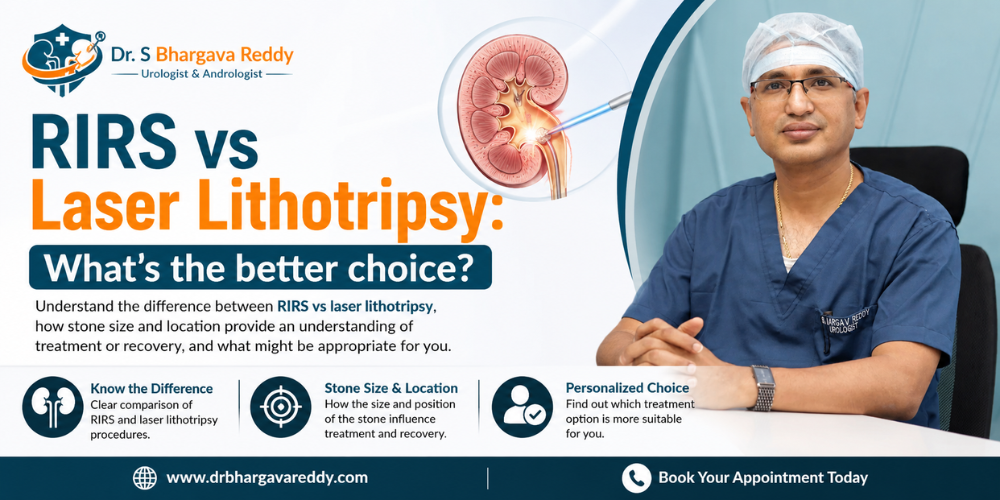
Much of the confusion begins because RIRS vs laser lithotripsy sounds like a choice between two totally different procedures. In fact they can be very closely related. The technique that is used to reach the kidney stone is called RIRS; laser lithotripsy is one technique used to break the stone.
Understanding this difference can help to make treatment decisions significantly easier.
How Does RIRS Treat Stones and What is It?
RIRS refers to Retrograde Intrarenal Surgery. A relatively non-invasive way of gaining access to stones located in the kidney or upper urinary tract. A ureteroscope is a thin, flexible instrument that is inserted into the urinary tract and into the kidney. This allows the surgeon to know where the stone is, so he or she can treat the stone without an incision.
During RIRS a laser is frequently used to reduce the stone to small fragments or fine dust. Holmium:YAG and thulium fiber lasers are now accepted as good tools for flexible ureteroscopy.
So, How Is Laser Lithotripsy Different?
Consider treatment as a journey.
The way to the stone is RIRS. Laser lithotripsy is the device that is used for breaking the stone.
Hard stone can be broken up into smaller stones with laser energy. Fragments can be extracted using a basket or be broken into very small pieces to pass naturally (depending on the stone/surgical plan).
Thus, it may be misleading to make comparisons between RIRS vs laser lithotripsy as entirely distinct treatments.
Which Kidney Stone Treatment is More Effective?
There is no one common winner.
There are many factors that need to be taken into account when it comes to the right kidney stone treatment. These include:
- Stone size
- Stone location
- The type and durability of stone
- Number of stones
- Kidney anatomy
- Previous treatment
- Blockage of urine or infection of the urinary tract.
- Overall health
RIRS with laser lithotripsy is a proven method of treatment for many renal stones less than 2 cm, which are not complicated. Other procedures (PCNL) may be required for larger or more complex stones, or sometimes staged RIRS.
When do Kidney Stone Size Call for Surgery?
While size is important, it’s not everything. Sometimes, a little stone in the wrong location may be difficult to treat as compared to a big stone in the right place in the kidney. The hardness of the stones also is important, as harder stones may not react in the same manner to treatment.
When looking for kidney stone size for surgery, keep in mind that not all patients will require surgery when the stones reach a certain size. An evaluation with a CT scan and the urologist decides if observation, medications, shock wave therapy, RIRS or another procedure is appropriate.
How does Laser Stone Removal Work?
When the ureteroscope is close to the stone, the doctor fires laser energy. The stone can be broken into pieces or carefully dusted.
With advancements in modern laser systems, it has become easier to treat urinary stones. For example, thulium fiber laser has been demonstrated to achieve a high stone-free rate and generally low complication rates for RIRS.
It is done under anaesthetic and the patient is not aware of the laser breaking the stone.
What Is Recovery Like After RIRS?
As a rule, recovery is easier than with procedures that involve a wider surgical opening. But there may be some temporary discomfort.
Patients might have some burning sensation while urinating, urinary frequency, haematuria or discomfort in the flank. Sometimes, a temporary ureteral stent may be inserted to allow urine to pass through it.
The length of the recovery period will vary based on the amount of stones, the type of procedure used, and how the patient responds.
When exploring the option of laser kidney stone treatment in Hyderabad, you should consult the urologist and inquire why a specific procedure is recommended for treating your kidney stone and not just opt for the treatment based on the size of the stone.
RIRS vs Laser Lithotripsy: What Should You Choose?
The answer is not necessarily RIRS vs laser lithotripsy.
In many instances, the two go hand-in-hand with the same treatment. RIRS allows access to the kidney and the laser lithotripsy helps to fragment the stone.
The best will vary based on your scan, stone characteristics, symptoms, and overall health. Consult a urologist who is qualified to offer you the right information on kidney stone treatment.